Introduction
The Quagensia® Desktop Application’s “Text” data type represents any kind of text, such as symbols for instruments as well as phrases and sentences such as alert messages that you can send to the output window or print on the chart to which your strategy is attached.
Programmers usually refer to text or words as “strings”.
Every edition of Quagensia has many “string manipulation” functions, meaning functions that can transform strings into other strings, such as making a string all upper case or extracting the first or last characters of a string.
The most popular string-related Quagensia Function is the one called “Convert Non-Text To Text”, because whenever you attempt to place a non-text expression, such as a number or date, at a location where text is expected, Quagensia will automatically wrap the non-text expression you selected inside of the “Convert Non-Text To Text” function so that your non-text expression will be automatically converted into text, allowing it to be used as text for such purposes as printing your non-text expression to the output window or printing it on the chart to which your strategy is attached.
Note that while the “Convert Non-Text to Text” function is the simplest of the Quagensia Functions that convert non-text to text, it offers the least control over the text to which the non-text expression is converted because it simply converts the non-text expression to a text expression using the default formatting for the data type of the non-text expression.
If you want to have more control over the format of the text to which a non-text expression converts, for example if you would like control over the number of decimal places in a piece of text that represents a decimal number, you should use a function that converts values of that specific data type (number, date, time, Boolean, etc.) into text using additional formatting parameters that you can pass to the function.
You can view all of the Quagensia Functions that convert non-text expressions into text expressions by navigating to the context menu subfolder “More Expressions >> Type Conversion”.
Quagensia N & T Editions have built-in functions for working with text.
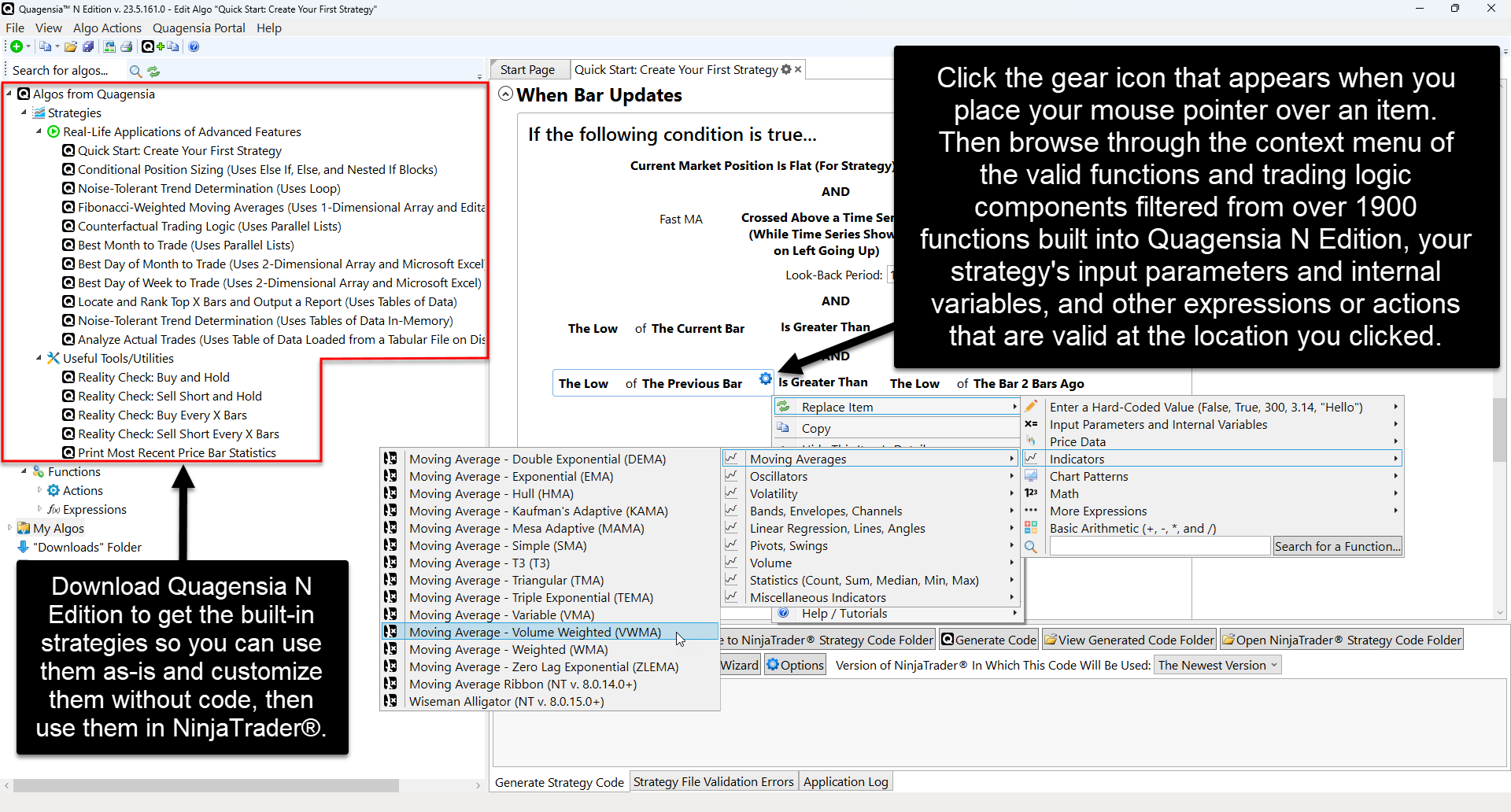
The no-code functions for working with text that are built into Quagensia N & T Editions are listed below with links to their help pages. Each of these expression functions is displayed in the same subfolder in which you can find it in the Quagensia Desktop Application’s Algo Explorer and in the context menu that appears when you click on a location on your Quagensia Algo’s workspace where the expression function is allowed to be used.
The next section lists the functions for working with text that are built into Quagensia N Edition. You can also scroll down to the list of functions for working with text that are built into Quagensia T Edition further down on this page.