Introduction
Quagensia® N Edition’s innovative Quagensia Table System makes it easy to load tables of many kinds of data, not just time series data, from tabular data files into in-memory data tables that you can query, modify, and then write back to tabular data files on disk from your strategies.
If you have valuable data in Microsoft Excel files, a database such as Microsoft SQL Server, SQLite, or MySQL, if you have access to exotic data via Bloomberg® Terminal®, Refinitiv® Eikon®, or another high end institutional platform, if you have tabular data output from MATLAB® or R, or if you have access to alternative data sources on the internet, it is generally very easy to get these kinds of data into comma-delimited, semicolon-delimited, or otherwise character-delimited tabular data files. And once you do, it is easy to get all of this data, even entire databases of data, into your NinjaTrader® strategies by simply clicking choices on a screen.
You can also create in-memory data tables and populate them with data from scratch, i.e. not from tabular data files, and then create, modify, and delete rows from these in-memory data tables.
Regardless of how you create your in-memory data tables, Quagensia N Edition makes it easy to write that data to tabular data files on disk.
This allows you to run a backtest or optimization of a NinjaTrader® strategy that outputs a report containing tabular data that you can load into any database, use as input data in MATLAB® or R, or load into Microsoft Excel to manipulate further and use to create visually powerful charts and graphs that answer your questions about the markets in ways that backtest performance reports cannot.
All features just described work with data columns of 89 different types of data including: 10 numeric data types, 3 date/time data types, colors, Booleans (true or false), text, and 73 “lists of choices” data types such as the months of the year or the days of the week.
The Quagensia N Edition Runtime Setup Assistant
Reading and writing tables of data to and from tabular data files from within your Quagensia N Edition strategies only works if the proper version of the QuagensiaRuntime.dll file is present in the NinjaTrader® Bin-Custom folder.
If the proper version of the QuagensiaRuntime.dll file is not present in the NinjaTrader® Bin-Custom folder when you generate the code for a Quagensia Strategy that uses the Quagensia Table System, the Quagensia N Edition Runtime Setup Assistant window will automatically open and will guide you through the quick and easy process of importing a NinjaScript® add-on file that comes with Quagensia N Edition into NinjaTrader®, which will copy the proper version of the QuagensiaRuntime.dll file into the NinjaTrader® Bin-Custom folder.
This assistant will also help get you fully set up to use Quagensia N Edition’s “Control Panels” feature, which makes it quick and easy to add buttons, check boxes, text boxes, and labels to the NinjaTrader® charts to which your Quagensia N Edition Strategies are applied and add no-code trading logic that will be executed when the buttons are clicked to create both simple control panels as well as complex rich trading applications that best match your discretionary or semi-automated trading style. This assistant will guide you through the process of selecting your preference for Quagensia N Edition Runtime license type (either email address-based or NinjaTrader Machine ID-based licensing), and (for users whose free trials have expired) requesting and obtaining a paid Quagensia N Edition Runtime license for either your email address or your one or two NinjaTrader® Machine IDs.
If you only want to use Quagensia N Edition’s “Tables of Data” feature you do not need a Quagensia N Edition Runtime license, but if you also want to use the Control Panels feature you will need one.
Creating and Using Your First Tables of Data
Watch the video tutorial at the top of this page and follow along to get up and running quickly with Quagensia N Edition’s innovative Quagensia Table System.
Becoming an Expert at Using the Quagensia Table System
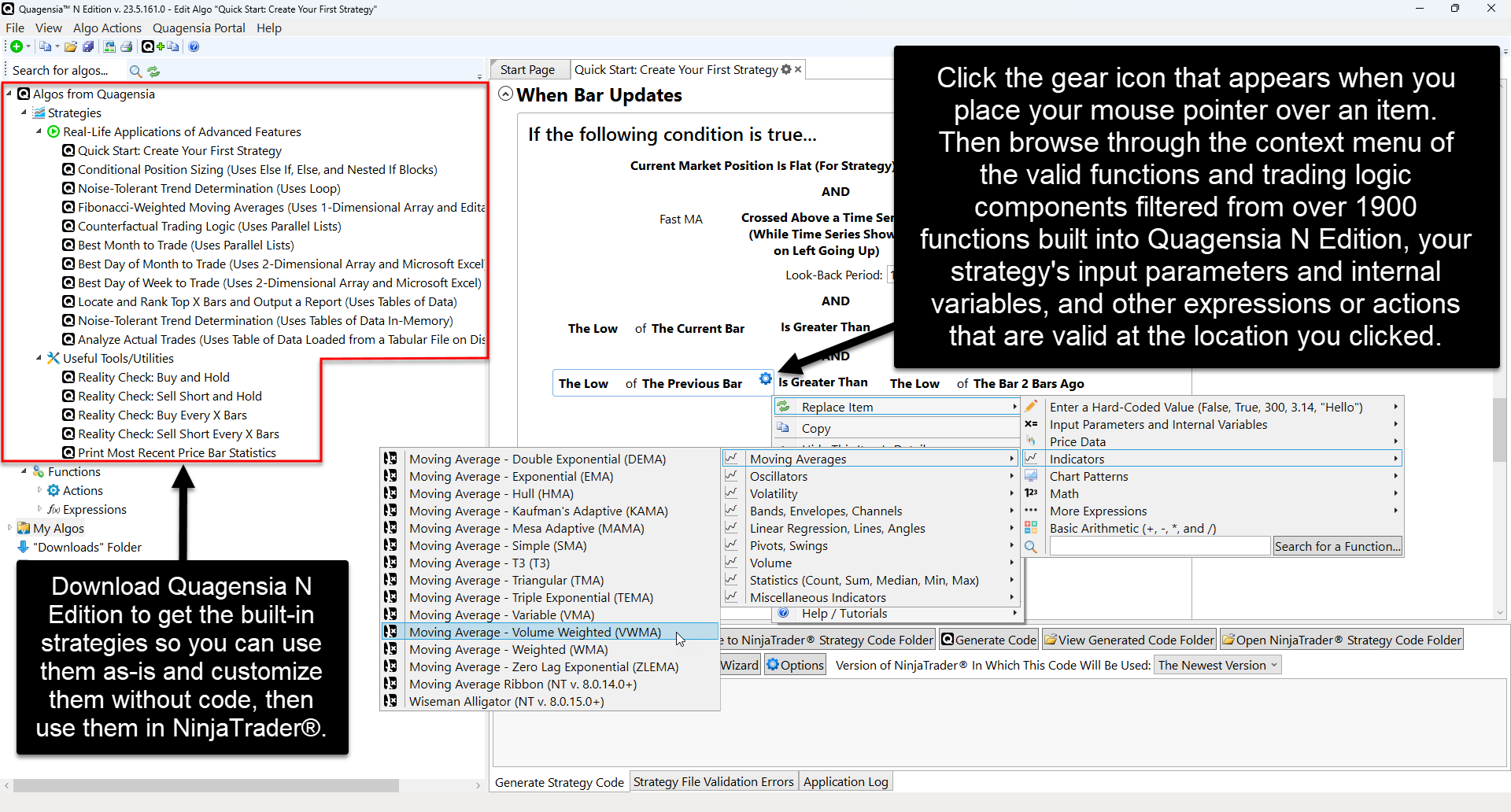
To become an expert at using the Quagensia Table System, you can browse through all the table-related Quagensia Action Functions and Quagensia Expression Functions using either the context-sensitive context menu that opens when you click on a location on the algo workspace where an action or expression is allowed or by navigating though the folders in the Algo Explorer on the left side of Quagensia N Edition’s main window.
You can browse through the table-related Quagensia Functions in a context-sensitive manner by clicking on a location on the algo workspace where an action or expression is allowed and navigating to the following context menu subfolders:
- Table-related Quagensia Action Functions are located in the context-sensitive context menu subfolder “More Actions > Tables and Tabular Data Files”.
- Table-related Quagensia Expression Functions are located in the context-sensitive context menu subfolder “More Expressions > Tables and Tabular Data Files”.
Keep in mind that when you browse through table-related functions in a context-sensitive manner by clicking a location on the algo workspace you are only seeing functions that are allowed to be added at that location.
You can also browse through the complete, unfiltered list of table-related Quagensia Functions in a non-context-sensitive manner using the Algo Explorer on the left side of Quagensia N Edition’s main window by navigating to the following folders in the Algo Explorer:
- Table-related Quagensia Action Functions are located in the Algo Explorer’s subfolder “Algos from Quagensia > Actions > More Actions > Tables and Tabular Data Files”.
- Table-related Quagensia Expression Functions are located in the Algo Explorer’s subfolder “Algos from Quagensia > Expressions > More Expressions > Tables and Tabular Data Files”.
Table-related Quagensia Functions are very well-documented. The documentation for each table-related Quagensia Function is written directly in the function’s description and in the descriptions of the function’s input parameters. You can read both a function’s description and the descriptions of its input parameters in multiple ways:
- If a function’s entire documentation can fit in a tooltip, you can read its complete documentation in the tooltip that appears when rolling your mouse pointer over the icon to the left of its context-sensitive context menu item.
- If a function’s entire documentation cannot fit in a tooltip, you can read its complete documentation in the Context-Sensitive Help Panel when you roll your mouse pointer over the function’s context-sensitive menu item. To learn more about context-sensitive help, read the article Using Context-Sensitive Help.
- You can also open a table-related Quagensia Function in a new tab in Quagensia N Edition and read the function’s documentation directly on its algo workspace in multiple ways. You can do this from the Algo Explorer by clicking on its Algo Explorer item then choosing “View Function” from the context menu that appears. You can also do this first by clicking on the function’s context-sensitive context menu to add it to the algo workspace of either a Quagensia Strategy or another Quagensia Function and then, on the algo workspace on which is was added, clicking on the gear icon on its right side and selecting “Open This Function”.