Learn as you work with real-time context-sensitive help.
The real-time context-sensitive help built into the Quagensia® Desktop Application is much better than any comprehensive textbook, because it allows you to learn about the things you need to learn about, when you need to learn them, and not worry about the thousand other things that may be of use to you someday.
You can access real-time context-sensitive help as you build your own Quagensia Strategies and Quagensia Functions through both tooltips as well as the real-time help that appears in the Context-Sensitive Help panel.
Learn about whatever is under your mouse cursor by viewing its tooltip.
Almost every item over which you can place your mouse cursor has an informative tooltip telling you what it is and often telling you how to use it.
That said, tooltips would be too distracting and would get in the way of your work if they appeared whenever your mouse cursor was over any pixel of the Quagensia user interface, so tooltips are intentionally only added to small parts of most items so that you will usually only see them when you explicitly request to see them by placing your mouse over the user interface elements that have been designated as tooltip-enhanced.
To view an item’s tooltip, place your mouse pointer over any of the following tooltip-enhanced user interface elements:
- The label next to any editable field.
- The icon in the right or upper right of any item on the algo workspace. These tooltip-enhanced icons appear when you place your mouse pointer over some part of the item.
- Any column header or any list of data types in the “Type” column of the main grid in the Input Parameters or Internal Variables sections.
- Any button anywhere, whether the button appears as a 16×16 pixel icon, a larger sized button, or a link button.
- Any 16×16 pixel icon to the left of any main menu item, context menu item, or Algo Explorer tree item.
Learn about whatever is under your mouse cursor by viewing its description and links to its related online help documentation in the Context-Sensitive Help panel.
The Quagensia Desktop Application’s Context-Sensitive Help panel displays complete descriptions of the most important items over which you place your mouse, and also displays links to all the related online help documentation for the item, sorted from most relevant or specific to an item to most general, so that the last link will always send you to the main help page.
The Context-Sensitive Help panel is displayed on the right side of the Quagensia user interface whenever you open Quagensia.
If the “Refresh Help Links in Real-Time” check box on the bottom of the Context-Sensitive Help panel is checked, then both the descriptions and the help links are updated whenever you hold your mouse cursor over an item that has context-sensitive help for a short amount of time.
If you find this too distracting while you are trying to work, you can either uncheck the “Refresh Help Links in Real-Time” check box or close the Context-Sensitive Help panel.
To open the Context-Sensitive Help panel again, either press the F1 key or click on the main menu item “View >> View Quagensia Help”.
If the Context-Sensitive Help panel is visible but the “Refresh Help Links in Real-Time” check box is unchecked, you can update the description and related web links for an item under your mouse cursor by pressing F1.
Note that pressing the F1 key also opens up the most relevant online documentation for the item under the mouse cursor.
One advantage of the descriptions of items in the Context-Sensitive Help panel over the same descriptions when displayed in tooltips is that if the description of an item is really long, a vertical scroll bar will appear next to the Context-Sensitive Help panel’s description whereas very long descriptions in tooltips may get cut off.
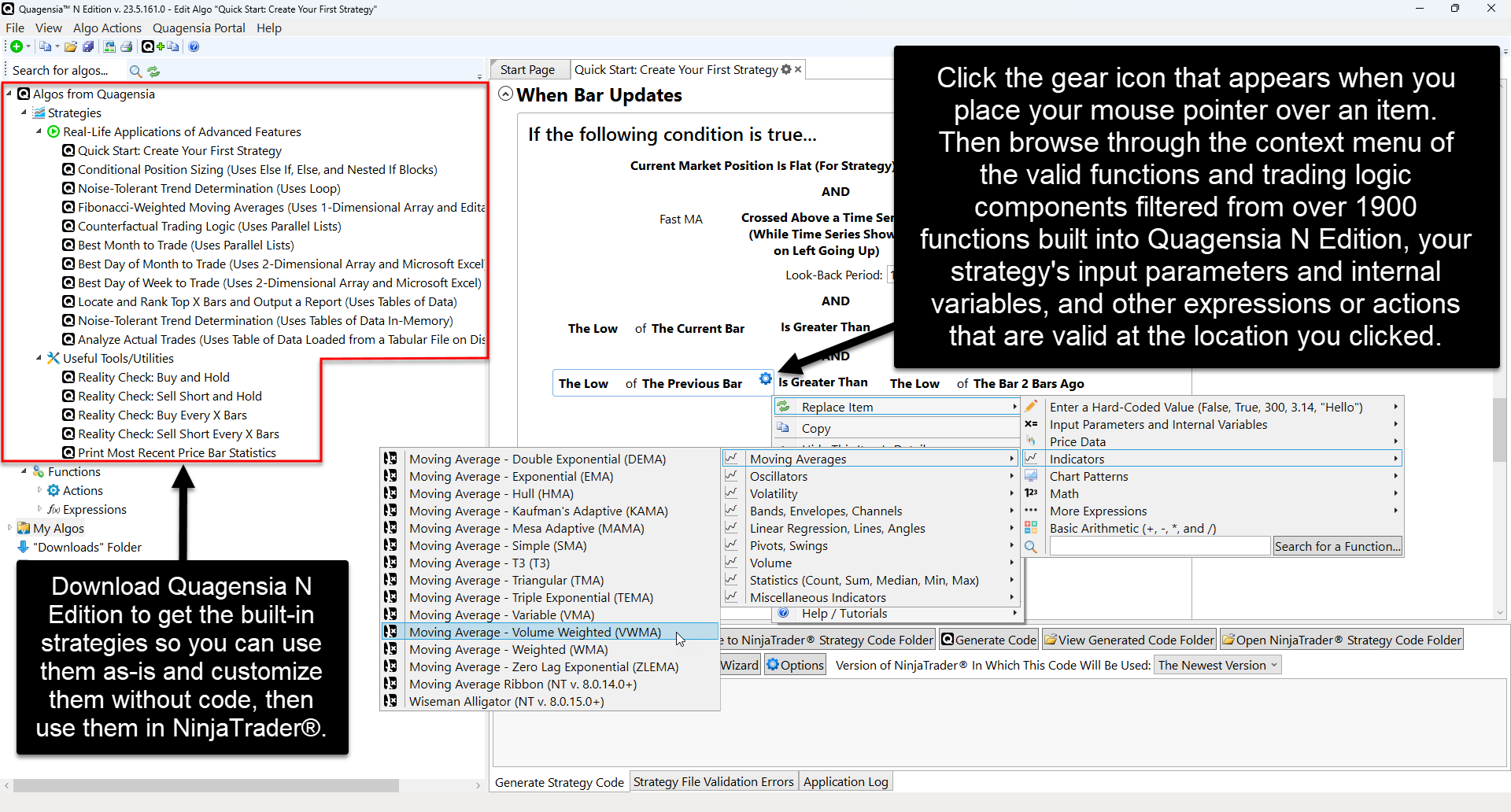
Even the context-sensitive action and expression context menu items display real-time context-sensitive help.
Note that the Context-Sensitive Help panel also displays real-time information for the expressions and actions in the menu items in the context menus that appear when you click on a location in an algo that expects an expression or action.
This allows you to read the descriptions of and read the online help for any expression or action that you are considering placing at a location in your algo that accepts an expression or action, so long as this information exists for a given expression or action. This is a great way to quickly learn about all of the functions and components of a certain type when you click on a location on your algo’s workspace.
When you open your first Quagensia Strategy or Quagensia Function, you will be presented with a small number of “onboarding cards” to help you get started using Quagensia productively in the least amount of time with a minimum of frustration.
As good as the real-time context-sensitive help inside of Quagensia is, you may not be fully aware of all the ways that you can use it, you may not know how best to start learning Quagensia, and no matter how the good the real-time context-sensitive help is, sometimes it is important to display certain information front and center where you cannot miss it.
To address these challenges, you will be presented with yellow “onboarding cards” when you open your first Quagensia Strategy or Quagensia Function inside of Quagensia.
All onboarding cards include links to web pages on this website which have the best introductory videos for new Quagensia users. Some onboarding cards present users with the best general “getting started” videos, while other onboarding cards warn users about potential pitfalls that may be counterintuitive for most users new to either Quagensia or to the trading platforms for which Quagensia generates code.
Each edition of Quagensia has a different set of onboarding cards, and Quagensia Strategies and Quagensia Functions also have different onboarding cards.
Once you feel that you fully understand the information presented both in a given onboarding card and in the video to which it links, you can hide the onboarding card permanently by clicking its “Hide This Onboarding Card Permanently” link button.
You can also click an onboarding card’s link button titled “Remind Me Later” to make the onboarding card disappear for the remainder of your session. When you do this, the onboarding card won’t be displayed until you open a new instance of Quagensia.
If you accidentally click the “Hide This Onboarding Card Permanently” link button or if you decide that you want to re-study all of the onboarding cards for a given edition of Quagensia, you can click on the menu item located in the main menu at “View >> View All Onboarding Cards Again” and confirm that you really want to view them all again, and Quagensia will treat you like a new user who hasn’t dismissed any of the onboarding cards yet.