Introduction
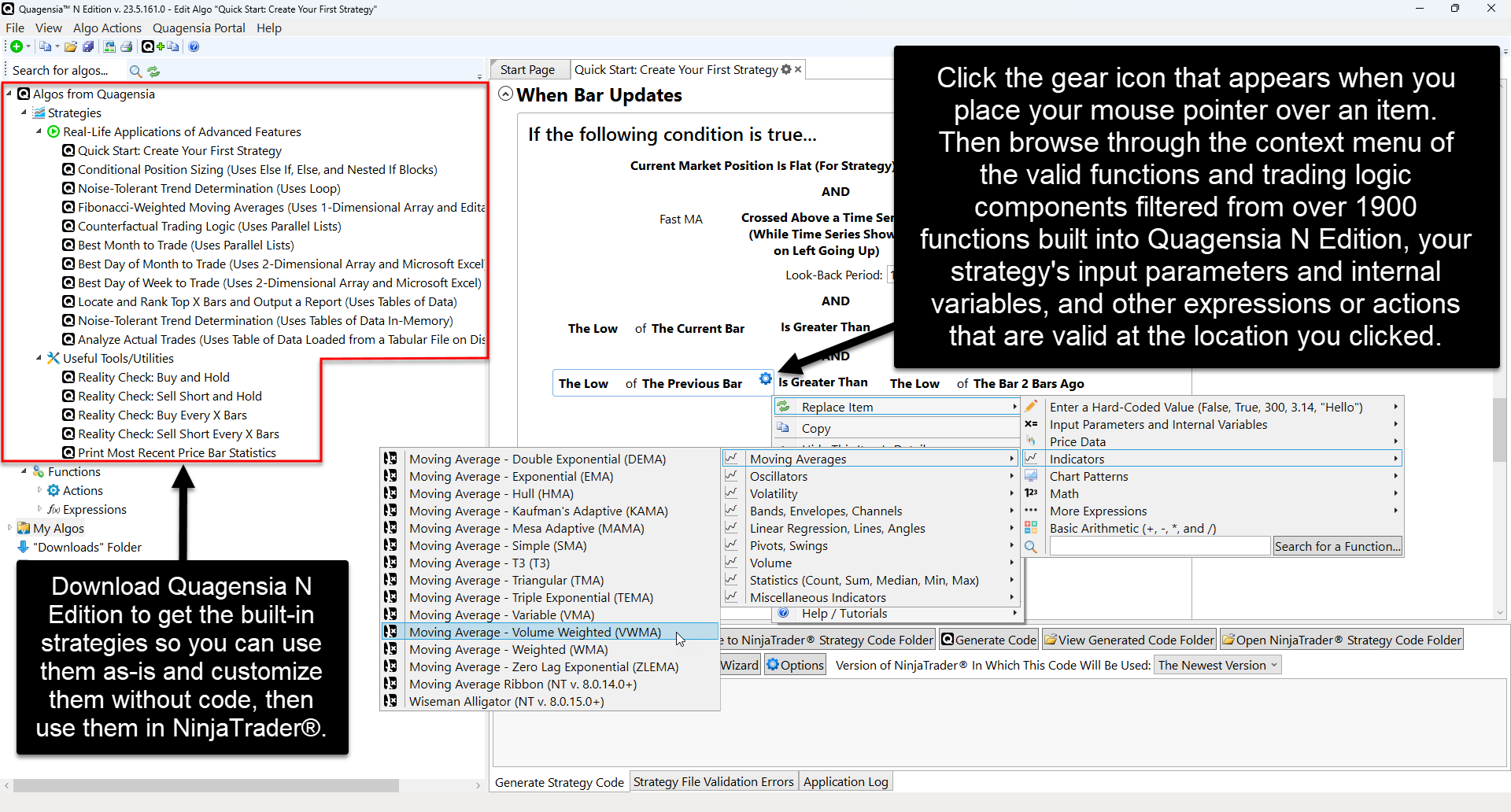
The Algo Explorer is the pane on the left side of the Quagensia® Desktop Application user interface.
It consists of four folders and and a tool bar.
The Four Folders of the Algo Explorer
Folder #1: The “Algos from Quagensia” Folder
The “Algos from Quagensia” folder represents the folder on disk that holds the Quagensia Algo files that were installed with Quagensia.
WARNING: Do not put any of your own files or folders in this folder because it gets overwritten by Quagensia when you install the newest version of this application and may get overwritten for other reasons as well.
Right click it to see what you can do with it.
Folder #2: The “My Algos” Folder
The “My Algos” folder represents the folder on disk in which you should place all of your Quagensia Algo files.
When you save a Quagensia Algo file for the first time, Quagensia will default the suggested folder path in the “Save As” dialog box to your “My Algos” folder.
Quagensia Algo files can be saved to and opened from any folder, but the best place to save your Quagensia Algo files is in your “My Algos” folder, or in a subfolder of your “My Algos” folder for many reasons, including the following:
- It makes them easy to organize and find in the “My Algos” folder of the Algo Explorer.
- Quagensia Algo files stored in the “My Algos” folder can be found easily using the “Search” window.
- You can make a backup of this folder with a single button click from the “Manage Backups” window.
- Quagensia is able to use the Quagensia Function files in this folder as components that can be used in other Quagensia Algo files. For example, if you save a Quagensia Function file that does a proprietary calculation and then you put it in this folder or one of its subfolders, you can then use that calculation in any other Quagensia Algo file that you create. Additionally, if you share this Quagensia file with other people who put it in their “My Algos” folder, they can use your calculation also.
Right click your “My Algos” folder to see what you can do with it.
Folder #3: The “Downloads” Folder
The “Downloads” folder is a shortcut to the folder where all your web browser-initiated file downloads are saved.
When you download Quagensia Algo files that you want to use, right click on this folder shortcut and pick the menu item to open it, unzip the folder or file if necessary, then place the unzipped folders or files in your “My Algos” folder or a subfolder of your “My Algos” folder.
You can open the “My Algos” folder by right clicking on it in this application and picking the menu item that opens it.
You can copy the files between the two folders the way you normally copy files between folders, such as by using Windows File Explorer.
When you create, modify, or delete files or folders in the “My Algos” folder using Windows File Explorer, Quagensia will ask you if you want to reload the Algo Database so that the files and folders that exist on disk will also be properly reflected in the Quagensia user interface. Clicking “Yes” will reload the Algo Database and you will see the changes reflected in the “My Algos” folder in Quagensia.
Right click your “Downloads” folder to see what you can do with it.
Folder #4: The “Backups” Folder
This is the folder that holds all of the backups of your “My Algos” folder and your Quagensia User Folder that you explicitly ask the application to make.
Right click your “Backups” folder to see what you can do with it, such as making a backup of your “My Algos” folder or your entire Quagensia User Folder.
The Algo Explorer Tool Bar
The Algo Explorer tool bar has two features:
- A search text box and button that allow you to search for Quagensia Algos already on your computer, and search for downloadable Quagensia Algos and Quagensia-enhanced content at Quagensia.com and across the web.
- A button that allows you to reload the Algo Database. This is rarely necessary since when you create, modify, or delete files or folders in the “My Algos” folder using Windows File Explorer, Quagensia will ask you if you want to reload the Algo Database so that the files and folders that exist on disk will also be properly reflected in the Quagensia user interface.