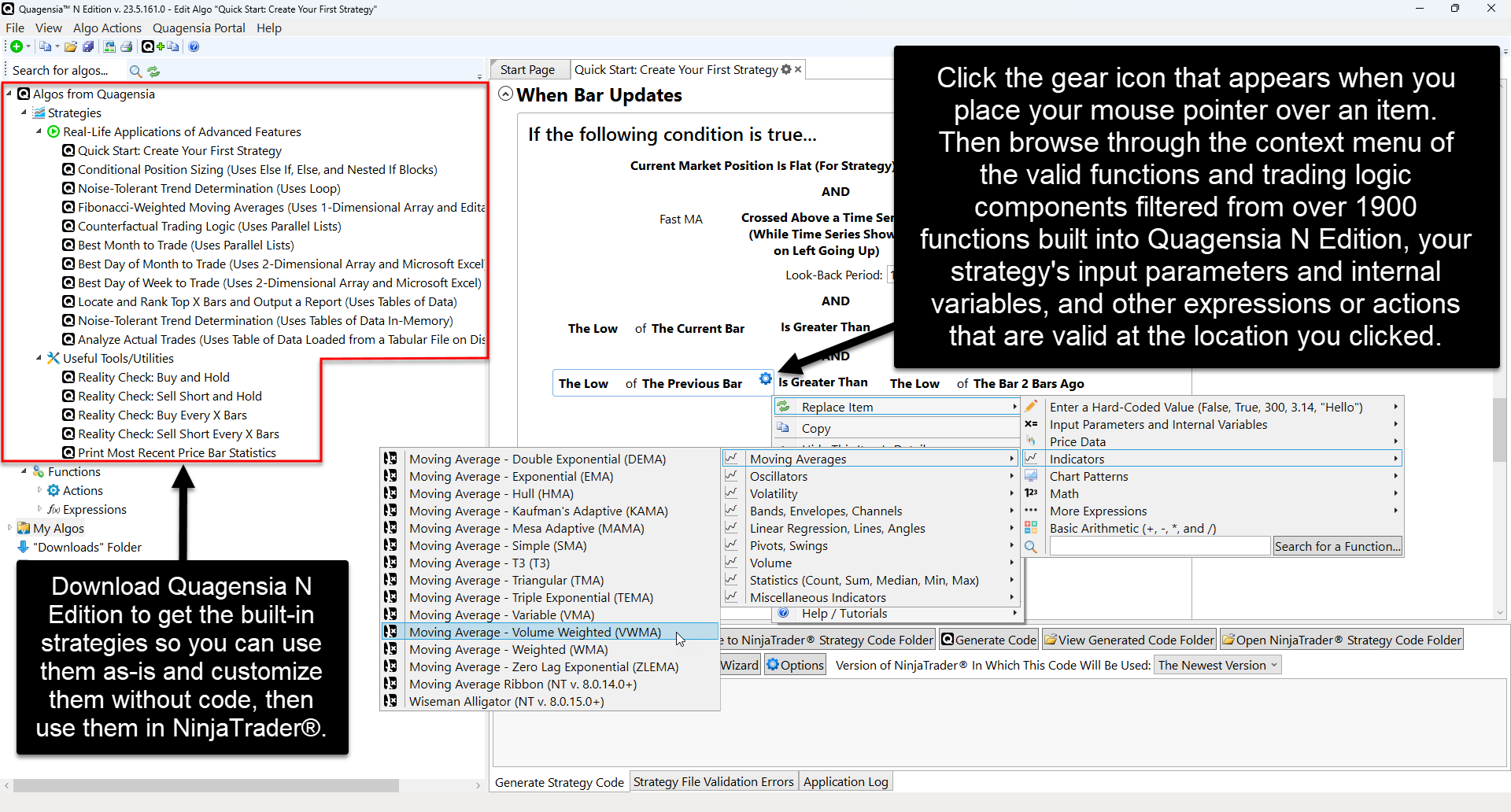
The Quagensia® Desktop Application supports data types that can be represented as lists of named choices, such as the seven days in a week.
Programmers call these data types “enumerated constants” because they consist of a certain known number of named “constant” values, for example seven named constants like “Monday” or “Tuesday” that are set to the values 1 through 7 and that together represent the names of the seven days in a week.
“Enumerated constants” are very helpful data types because they allow programmers to write code that is easier to write and easier for others to read, because for example their code can use the names of the days of the week rather than the numbers 1 through 7 to represent the days of the week. It is easier, for example, to understand the code “If DayOfWeek Equals Wednesday” than to understand the code “If DayOfWeek Equals 3”.
You can see the full list of “List of Choices” data types supported by your edition of Quagensia by clicking on the drop down list in the “Type” column of the Input Parameters section or Internal Variables section, and expanding the “Advanced Data Types >> Lists of Choices” folder in the drop down list. To see the list of choices for one of the “List of Choices” data types, click on one of the data types in the “Advanced Data Types >> Lists of Choices” folder to select that data type, then in your strategy, click on the new drop down list that appears to the right of the “Type” drop down list.
Some of the “List of Choices” data types in Quagensia represent actual enumerated constant data types that exist in the trading platform’s programming language, and other “List of Choices” data types represent lists of constant values in a trading platform’s programming language that represent a “logical” list of choices, even if the list of choices doesn’t exist as an actual enumerated constant in the trading platform’s programming language. For instance, if a trading platform’s programming language doesn’t have a “Seven Days of the Week” enumerated constant but does have a constant value for each day of the week, for example by using the number 1 to mean “Monday”, 2 to mean “Tuesday”, etc., your edition of Quagensia may have a “List of Choices” data type that represents a “conceptual” or “logical” “Seven Days of the Week” enumerated constant. There are even some special “List of Choices” data types that are used by one or more editions of Quagensia that represent lists of choices that are only used internally by the Quagensia Desktop Application itself or are only used by code created by Quagensia and do not represent any particular type of data in the trading platform’s programming language.
Variables of the Quagensia Desktop Application’s many “List of Choices” data types are just like numeric variables or any other kind of variable. They can be set to different values from the “Set a Variable” action, and the value to set your variable equal to can be selected manually from another drop down list of that “List of Choices” data type’s list of choices, can be set to the value of another “List of Choices” variable of the same data type, or can be the return value of a Quagensia Function that returns a “List of Choices” value of the same data type. You can create time series containing one “List of Choices” value for each or your primary instrument’s price bars, lists of “List of Choices” values, single-dimensional and multi-dimensional arrays of “List of Choices” values, and Quagensia Functions that accept “List of Choices” values as input parameters and return “List of Choices” values either as return values or by passing a “List of Choices” variable into the Quagensia Function by reference and setting it from within the function.
The Quagensia N Edition Indicator Import Process Also Imports Over 200 “List of Choices” Data Types
The Quagensia N Edition indicator import process also imports over 200 “List of Choices” data types that you can use in your Quagensia N Edition Strategies as input parameters that appear as (optimizable!) drop-down lists in NinjaTrader®, drop-down list internal variables in your strategies, or drop-down lists in your strategies’ trading logic.
You can quickly import over 200 “List of Choices” data types, as well as your third-party NinjaTrader® indicators, custom NinjaTrader® indicators, and enhanced versions of the NinjaTrader® indicators built into Quagensia® N Edition, as long as the “List of Choices” data types and indicators are currently supported by Quagensia N Edition, by following the quick and easy steps in the tutorial video below:

For more information about automatically importing “List of Choices” data types and indicators from NinjaTrader® into Quagensia N Edition, see this help page: How to Import (or Re-Import) Your Third-Party NinjaTrader® Indicators Into Quagensia N Edition By Applying a No-Code Strategy to a Chart in NinjaTrader®.
The Over 200 “List of Choices” Data Types Imported Into Quagensia N Edition Work Everywhere Except in the Quagensia Table System
A note to our most advanced Quagensia N Edition users that use Quagensia® N Edition’s innovative Quagensia Table System, which makes it easy to load tables of many kinds of data, not just time series data, from tabular data files into in-memory data tables that you can query, modify, and then write back to tabular data files on disk from your strategies:
The Quagensia Table System works with data columns of 89 different types of data including: 10 numeric data types, 3 date/time data types, colors, Booleans (true or false), text, and 73 built-in “list of choices” data types such as the months of the year or the days of the week, but the Quagensia Table System does not work with imported “list of choices” data types, only the 73 built-in “list of choices” data types.