Watch the video below to get a quick introduction to each of the advanced built-in no-code strategies in Quagensia® N Edition so that you can use them as-is and customize them without code, then use them in NinjaTrader®.
You will learn the basics of what each strategy does, how to get detailed information on using the strategies, how to use them as-is in NinjaTrader® 8, and the general process that you can use to customize them without code.
Video Transcript: The Advanced Point-&-Click Strategies for NinjaTrader® Built into Quagensia N Edition
Hi, I’m Brook from Quagensia,
And in this video, I will give you a quick introduction to each of the built-in no-code strategies in Quagensia N Edition so that you can use them as-is and customize them without code.
You will learn the basics of what each strategy does, how to get detailed information on using the strategies, how to use them as-is in NinjaTrader® 8, and the general process that you can use to customize them without code.
For a much more detailed tutorial that will teach you how to customize the built-in strategies without code, please watch the video titled “Introduction to Quagensia N Edition”, which is on our home page at quagensia.com and is linked to here. It will guide you through making a Quagensia N Edition Strategy from scratch and show you the power of Quagensia N Edition and what you can do with it without code. You can then come back and watch this video and customize each of the built-in strategies without code.
All the built-in no-code strategies you see here are free for all users of Quagensia N Edition, and you can even customize them for free during the free trial period without any programming knowledge by simply clicking choices on the screen.
If you’ve already watched the video titled “Introduction to Quagensia N Edition”, you know that Quagensia N Edition makes it easy to create simple yet useful algorithmic trading strategies for NinjaTrader® 8 without code. Most of the strategies that most new users of Quagensia N Edition will want to create on a day-to-day basis will be like the simple one we built from scratch in that video, with some basic entry and exit rules that when true cause the strategy to submit orders to the backtest engine or to a live market, draw on the chart, and write messages to the NinjaScript® Output window.
Most of the strategies you will learn about in this video are significantly more complex than the one you learned how to make from scratch in that video.
In this video you will see how Quagensia N Edition really shines when it comes to enabling you to create advanced, complex trading strategies that are better able to model your most complex trading ideas by using features like loops, lists, single-dimensional arrays, multi-dimensional arrays, editable time series and tables of data from Quagensia N Edition’s innovative table system.
Before we begin, it should be noted that Quagensia N Edition is a product of Quagensia, Inc., a company which has no affiliation with NinjaTrader, LLC.
Also, NinjaTrader® and NinjaScript® are registered trademarks of NinjaTrader, LLC.
Right before making this video, I followed the steps in the video titled “Introduction to Quagensia N Edition” to open up NinjaTrader® 8, connect to a source of market data by clicking here, open the NinjaScript® Editor by clicking here, and open the NinjaScript® Output window by clicking here. Then, I opened each of the built-in strategies in their own tabs in Quagensia N Edition as I am demonstrating here and clicked this button, titled “Generate Code and Copy Code File to NinjaTrader® 8 Strategy Code Folder” for each of them to generate each built-in strategy’s code and send it to NinjaTrader® 8. Since the NinjaScript® Editor was open before sending the code to NinjaTrader® as it should be, the code of each of the strategies was automatically compiled by NinjaTrader® into a format that it understands, which made the strategies ready to be backtested in the NinjaTrader® 8 Strategy Analyzer. Then I opened a separate NinjaTrader® 8 Strategy Analyzer window for each of the built-in strategies by clicking here one time for each strategy and ran a quick backtest for each of the strategies over many years of historical market data for the symbol SPY. SPY is the symbol for the SPDR S&P 500® ETF, which is designed to track the S&P 500®.
To learn more about a built-in strategy that appears in this video, first open the strategy in its own tab in Quagensia N Edition by clicking on it and selecting “View Strategy” like this.
You can get a good overview of a built-in strategy and specific instructions on its proper use in NinjaTrader® by reading its “Description and Notes” field.
If you want to learn more, you can scroll down and read through the visible logic and yellow “Comments” such as this one. Some of the built-in strategies also have one or more yellow “Comments” such as this one that start with “Attention paid users and users whose free trials have not expired” that explain a simple customization that can be made to the strategy without code, and without needing to understand the other more advanced aspects of the strategy.
To learn even more, you can expand all the contracted sections and hidden logic. When you do this the first time in a built-in strategy, it will warn you that your changes to the strategy will be ignored because the strategy file is a read-only file template. You can safely ignore this message and click “OK”. If you make an editable copy of a built-in strategy, you can customize it and expand the contracted sections and hidden logic without seeing this warning.
You can expand the “Input Parameters” section by clicking on its header like this if it is not already expanded and read the descriptions of a strategy’s input parameters.
You can expand the “Internal Variables” section by clicking on its header like this if it is not already expanded and read the descriptions of a strategy’s internal variables.
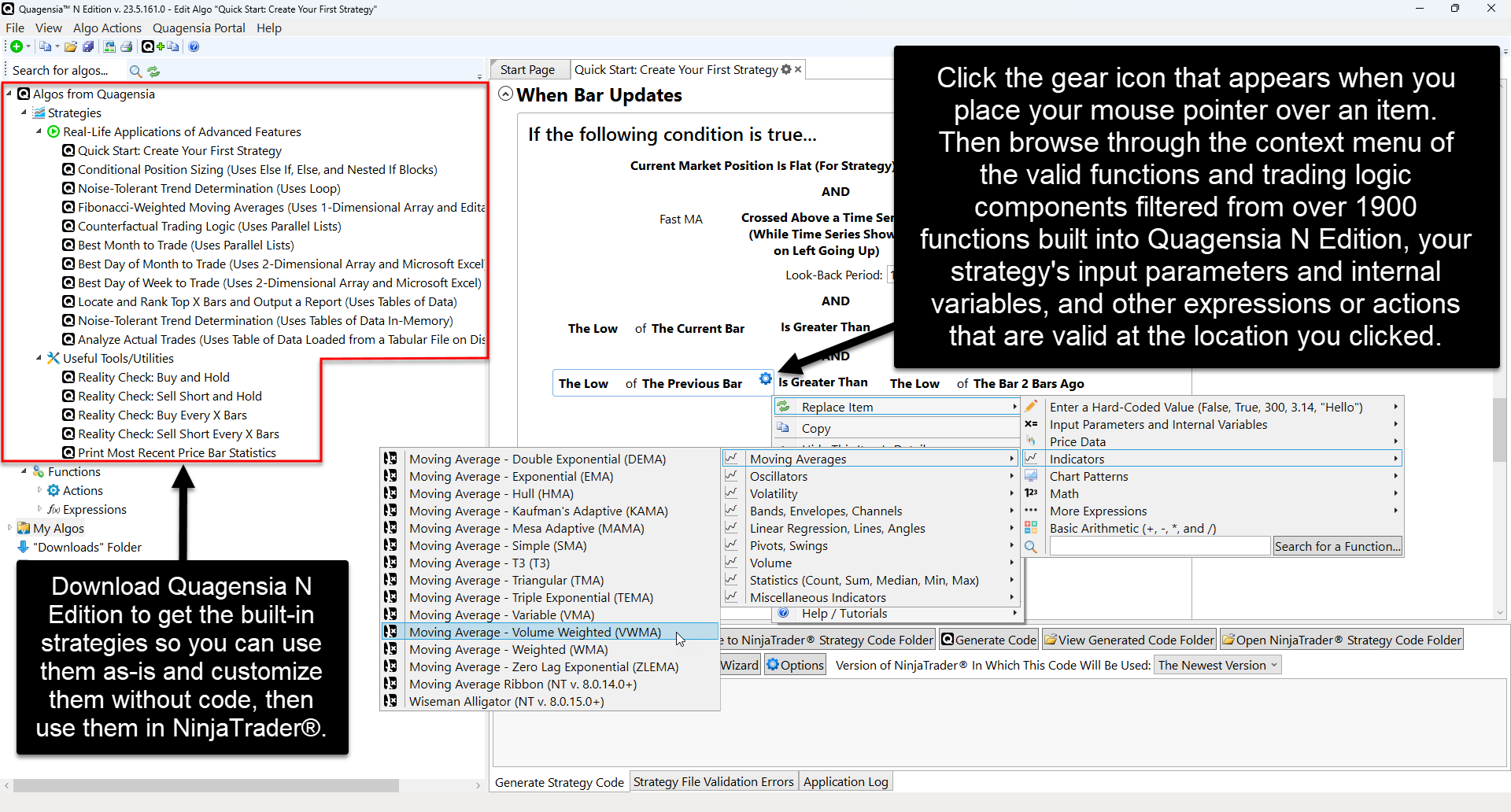
Most of the built-in strategies also have blue rectangles like this one that contain more advanced logic that was required to build the strategy. To view the logic hidden in these blue rectangles, click on one of them then select “Show This Item’s Details” from the context menu that appears. You can hide the logic again by clicking the gear icon in the upper right of the expanded logic and selecting “Hide This Item’s Details”.
Now that you have the skills you need to get the most out of this video, I will give you a quick introduction to each of the built-in strategies in Quagensia N Edition.
This strategy, titled “Quick Start: Create Your First Strategy”, is a very simple trading strategy that is created from scratch in the “Introduction to Quagensia N Edition” video, which is linked to here. This is the video you should watch before our other instructional videos, including this one. Once you’ve watched it you will be able to quickly and easily create and test your own trading strategies, and you will have gained the skills needed to customize the built-in strategies without code in Quagensia N Edition and backtest them in NinjaTrader®. When you backtest this strategy in NinjaTrader® and select “Chart” from this drop-down list, a chart should appear with a slow and fast moving average, little diamonds that indicate entry and exit signal bars, and long entries and exits on some of the moving average crossovers, as determined by the logic in this Quagensia Strategy’s “When Bar Updates” section.
This strategy, titled “Conditional Position Sizing (Uses Else If, Else, and Nested If Blocks)”, is a basic moving average crossover strategy that demonstrates using conditional logic to determine the position size of a trade. This strategy is a simple example of the proper use of multiple “Else If” blocks, “Else” blocks, and “nesting” of conditional trading logic blocks inside of other conditional trading logic blocks. When you backtest this strategy in NinjaTrader® and select “Chart” from this drop-down list, a chart should appear with a slow and fast moving average, light green and pink vertical stripes of background color that indicate entry and exit signal bars, and long entries and exits on some of the moving average crossovers. Notice how the conditional position sizing logic produced different entry order quantities for bars that met different criteria.
This strategy, titled “Noise-Tolerant Trend Determination (Uses Loop)”, is a noise-tolerant trend following system that demonstrates using a loop to determine if something is true for each of the last X bars, where X is a positive number that can be set here. Specifically, this strategy enters a long position if the close prices of each of the last X bars are higher than the close prices of the bars Y bars before them, where Y is a positive number that can be set here. Each of the last X bars is compared to the bar Y bars before it. This method of trend determination is noise-tolerant because it can handle market action that has a low signal-to-noise ratio caused by a lot of apparently random price movements, price spikes, and countertrend movements mixed in with what to the human eye is a clear market trend. This strategy also demonstrates drawing larger rectangles, whose meanings are described here by this orange text, which also demonstrates how to write text on a chart at a fixed location such as the upper left corner.
This strategy, titled “Fibonacci-Weighted Moving Averages (Uses 1-Dimensional Array and Editable Time Series)”, is a moving average crossover system that uses a custom-built “Fibonacci-weighted moving average” instead of one of the moving averages built into NinjaTrader® by default, and demonstrates how to use single-dimensional arrays and “Editable Time Series”. The weightings used for the Fibonacci-weighted moving average are calculated up front when the strategy is initialized and stored in a single-dimensional array. On each bar update, the Fibonacci-weighted moving average of the close prices is calculated for the current bar using the weightings in the array and stored in an Editable Time Series, which is plotted as a blue dotted line on the chart. A long trade is entered if the Fibonacci-weighted moving average is going up and crosses above another Editable Time Series that is a smoothed version of the Fibonacci-weighted moving average, where the smoothing is done by calculating the simple moving average of the Fibonacci-weighted moving average.
This strategy, titled “Counterfactual Trading Logic (Uses Parallel Lists)”, uses the power of lists to create an easily customizable “counterfactual trading logic” system. It acts as a template strategy that allows you to plug in your own entry and exit logic to create a trading strategy that only places actual trades when your preferred number of most recent entry and exit signals “would have” produced trades either above or below your preferred profit level. This strategy uses lists to keep track of what “would have happened” if an actual trade had been entered every time your entry logic triggered and if those actual trades were exited every time your exit logic triggered to create a real-time, up-to-date historical list of possible trades and their hypothetical trading performance. In this strategy, the trades not taken despite the entry signal trigger occurring are referred to as “counterfactual trades” and appear on the chart as thin gray lines between what would have been the entry and exit bars with green and red dotted vertical lines drawn on the signal bars for the counterfactual entry and exit bars. The trades where actual entry and exit orders are placed are referred to as “actual trades” and appear on the chart with the order entry and exit markings and position markings that NinjaTrader® normally uses, with additional green and red dotted vertical lines and light green and pink vertical stripes of background color drawn on the signal bars for the actual entry and exit bars. Also, the bars between the actual entry and exit signal bars have a yellow background. The term “counterfactual trading logic” refers to trading logic that takes into account the performance that “would have been achieved” by the most recent “counterfactual trades” had they been “actual trades”.
To plug in your own entry and exit logic to create a trading strategy that only places actual trades when your preferred number of most recent entry and exit signals “would have” produced trades above or below your preferred profit level, make a copy of this built-in strategy by clicking on it and selecting “Create New Strategy from Copy of This Strategy”, changing its “Strategy Name”, changing its “Strategy Name Inside of NinjaTrader ® 8”, and saving the copy to your “My Algos” folder. Then, scroll down to the two yellow comments that start with “Attention paid users and users whose free trials have not expired” and follow the instructions to replace the default entry and exit logic with your own entry and exit logic without code.
For instance, you could create an entry condition that enters a position if the open of the current bar is more than 1% higher than the close of the previous bar as I will now demonstrate.
Let’s copy this entry condition and use it as a starting point for an exit condition.
Then, scroll up to the customizable exit condition set.
Then delete the “Cross Below a Time Series” condition.
Then paste the entry condition over the condition that says “True Is Equal To True”.
Then, you could create an exit condition that exits a position if the open of the current bar is more than 1% lower than the close of the previous bar as I will now demonstrate.
Then, click this button to save your customizations, generate your customized strategy’s code, and send it to NinjaTrader® 8.
As a reminder, you can learn how to customize strategies without code in Quagensia N Edition and backtest them in NinjaTrader® 8 by watching the “Introduction to Quagensia N Edition” video which is on our home page at quagensia.com and is linked to here.
This strategy, titled “Best Month to Trade (Uses Parallel Lists)”, uses the power of lists to create a report that allows you to quickly determine what the best and worst months of the year were to hold a long position for your instrument of choice. Follow the detailed instructions in the “Description & Notes” field here to run the backtest, then copy and paste the strategy’s report results from the NinjaScript® Output window into Microsoft Excel and format the report data to create a report that looks something like this.
To customize this report without code to only include the months that more closely match the current market conditions for your instrument of choice, make a copy of this built-in strategy as previously described, then scroll down to the yellow comment that starts with “Attention paid users and users whose free trials have not expired” and follow the instructions to customize the set of conditions here for which price bars should be included in and excluded from the results based on how you see the “current market conditions”. Then, click this button to save your customizations, generate your customized strategy’s code, and send it to NinjaTrader® 8.
For a detailed tutorial on using this strategy as is and customizing it without code, watch the video that is linked to here. And for a detailed tutorial on how to make this strategy from scratch, watch the video that is linked to here.
This strategy, titled “Best Day of Month to Trade (Uses 2-Dimensional Array and Microsoft Excel)”, uses the power of 2-dimensional arrays to create a report that allows you to quickly determine what the best and worst days of the month were to hold a long position for your instrument of choice. Follow the detailed instructions in the “Description & Notes” field here to run the backtest, then copy and paste the strategy’s report results from the NinjaScript® Output window into a custom Microsoft Excel workbook that you can download from this strategy’s home page on our website by clicking here and format the report data to create a report that looks something like this.
This strategy, titled “Best Day of Week to Trade (Uses 2-Dimensional Array and Microsoft Excel)”, uses the power of 2-dimensional arrays to create a report that allows you to quickly determine what the best and worst days of the week were to hold a long position for your instrument of choice. Follow the detailed instructions in the “Description & Notes” field here to run the backtest, then copy and paste the strategy’s report results from the NinjaScript® Output window into a custom Microsoft Excel workbook that you can download from this strategy’s home page on our website by clicking here, and format the report data to create a report that looks something like this.
This strategy, titled “Locate and Rank Top X Bars and Output a Report (Uses Tables of Data)”, uses tables of data from Quagensia N Edition’s innovative table system to get the list of the “top X” specified number of bars with the highest values for the metric of interest between the backtest start and end date, write the bar end time and the value for the metric of interest for each of the “top X” bars to a tabular data file using the Quagensia Table System’s tabular data file writing system and also write the results to the NinjaScript® Output window. It also marks up the “top X” bars on the chart to make it easy to quickly identify them when scrolling backward over all the bars between the backtest start and end date. When run as-is, without customizations, this report’s “metric of interest” is “% Change (From Bar Open Price To Bar Close Price)”, and every bar between the backtest start and end date is considered for inclusion in the “top X” bars for that metric. However, this report can be easily customized without code. You can easily change the “metric of interest” by changing a single calculation, and you can plug in your own conditions for which price bars should be considered for inclusion in the “top X” bars for that metric instead of considering all the bars for inclusion.
To customize this report, make a copy of this built-in strategy as previously described, then scroll down to the two yellow comments that start with “Attention paid users and users whose free trials have not expired”, follow the instructions in one comment to change the “metric of interest”, and follow the instructions in the other comment to plug in your own conditions for which price bars should be considered for inclusion in the “top X” bars for that metric instead of considering all the bars for inclusion. Then, click this button to save your customizations, generate your customized strategy’s code, and send it to NinjaTrader® 8.
Note that since this strategy is one of the three built-in strategies that use the Quagensia Table System, the Quagensia Runtime Dll Setup Wizard will open automatically the first time you generate the code for it or either of these other two strategies. Step 1 of this wizard just tells you to watch a video that explains what this wizard does and why it is so important. This wizard will guide you through the quick and easy process of copying the QuagensiaRuntime.dll file into the NinjaTrader® 8 Bin-Custom folder and adding a reference to the QuagensiaRuntime.dll file from within your current installation of NinjaTrader® 8 if you have never done so. Once you complete this wizard you will be able to use the most powerful features of Quagensia N Edition, such as the ability to read and write tables of data to and from tabular data files from within your NinjaTrader® 8 strategies and you will be able to use this strategy as well as the other two strategies here.
This strategy, titled “Noise-Tolerant Trend Determination (Uses Tables of Data In-Memory)”, is a more advanced noise-tolerant trend following system than the one that uses loops that was previously mentioned. This strategy demonstrates using tables of data from Quagensia N Edition’s innovative table system to determine if the percentage change for the current bar from the bar 10 bars ago for the high, low, and close are higher than those same three metrics for at least 15 bars whose three metrics were all positive and which were present in the 20 bars before the current bar. The numbers 10, 15, and 20 are just example values which can be changed using these input parameters.
This strategy’s logic is more complex than the logic of most of the other built-in strategies. Its logic is best understood by looking at its chart and reading the detailed description of its logic that appears on the chart and in the NinjaScript® Output window when this checkbox is checked before running the backtest. Once you’ve read the logic’s description, you can remove the description from the chart by unchecking this checkbox and running the backtest again. To help visualize this strategy’s more complex logic, it plots histograms on panels other than the main panel that contains the price chart, and it uses multiple drawing techniques including highlighting price bars or candles, drawing large rectangles, drawing vertical stripes of background color, displaying text that is attached to a price bar, and displaying text in a fixed position such as the upper left corner of the chart.
Note that since this strategy is one of the three built-in strategies that use the Quagensia Table System, the Quagensia Runtime Dll Setup Wizard will open automatically the first time you generate the code for it or either of these other two strategies as previously described.
This strategy, titled “Analyze Actual Trades (Uses Table of Data Loaded from a Tabular File on Disk)”, is the most advanced of all the built-in strategies and to use it you will have to read the entire “Description & Notes” field, which is quite long. Furthermore, this strategy requires a tabular data file of either your actual entries downloaded from your broker or entry signals from another source you wish to analyze. If you do choose to put the time and effort into learning how to use this strategy, however, you will be able to answer the following critically important questions:
Question Number 1: How many of your losing trades could have been avoided if you could have skipped all your trades that were made based on trading ideas or trading setups that didn’t work in the past, as determined by a quick backtest of a Quagensia Strategy?
Question Number 2: Is there a simple filter you could have applied to your criteria to enter trades in the past that would have filtered out many of your losing trades without filtering out too many of your winning trades, thereby improving your overall trading performance?
Question Number 3: How many of your exits for the trades that you took could have been improved by testing your exit strategies with some quick backtests and optimizations of a Quagensia Strategy that contained your exit logic?
Question Number 4: How good have the historical recommendations been from a given source such as an analyst, TV personality, market newsletter, trading idea website, Twitter handle, or other social media account?
Question Number 5: Which analysts or other sources of buy and sell signals have been the best and worst historically, and to what extent do different exit strategies affect the answer to this question?
Question Number 6: Had you entered a trade based on every historical recommendation from an analyst or other source of buy and sell signals, what exit strategies would have worked best?
This strategy helps you answer these questions by loading entry signals from a tabular data file on disk into a data table using Quagensia N Edition’s innovative table system, entering positions based on the entry signal times in the file for either all entries in the file or only for entries that match a set of entry filters that include matching a custom “category” from the file, having a custom numeric metric from the file that is between two values, and/or matching your own custom entry filter that you can create without code, and exiting positions based on a configurable trailing stop, profit target and/or time stop and/or your own custom exit logic that you can create without code.
The entry signals can be those of your actual historical trades downloaded from your broker, they can be entry signals that are recommendations from various analysts, TV personalities, market newsletters, trading idea websites, and Twitter handles or other social media accounts that issue buy and sell recommendations, or they can be entry signals that are generated by any other piece of software you use such as another trading platform, Bloomberg® Terminal®, Refinitiv® Eikon®, MATLAB®, or R.
If you are not in possession of a data file containing entry signals but would still like to test this strategy on an example data file with randomly generated entry signals, set the “If File Does Not Exist, Create an Example File with Random Trades” input parameter to “True”. The data file will be created at the file path to which the “File Path of Entry Signals to Load from Disk” input parameter is set and the backtest or optimization will run using this file. When you get a data file of actual entry signals you can replace this file of randomly generated signals with the file containing the real entry signals you want to analyze.
The file can contain entry signals for all the instruments you trade, the entry signals can be sorted in any order, and the file can have optional columns such as the order quantity, the category name and ID, and a custom metric that can be a decimal number or a whole number.
To learn how to use this strategy, you should read the following three sources of instructional material:
First, read this strategy’s very long “Description & Notes” field, as shown here.
Second, read the descriptions of this strategy’s many input parameters, as shown here.
Finally, read the messages in the yellow “comments” in this strategy’s “When Bar Updates” section, as shown here.
To add your own custom entry filter criteria and exit filter criteria to this strategy without code, make a copy of this built-in strategy as previously described, then scroll down to the two yellow comments that start with “Attention paid users and users whose free trials have not expired”, follow the instructions in one comment to add your own custom entry filter criteria, and follow the instructions in the other comment to add your own custom exit filter criteria. Then, click this button to save your customizations, generate your customized strategy’s code, and send it to NinjaTrader® 8.
Note that since this strategy is one of the three built-in strategies that use the Quagensia Table System, the Quagensia Runtime Dll Setup Wizard will open automatically the first time you generate the code for it or either of these other two strategies as previously described.
Although there is not nearly enough time in the video to provide you with a complete tutorial on this strategy, I will leave you with two pointers:
Pointer Number 1: If you are backtesting over 1-day daily bars, you should check the check box here, titled “Entry Signals Occurring After Hours Should Be Entered on Next Open (Daily Bars Only)”.
Pointer Number 2: If the entry times in your data file are not in New York time, this text box needs to be set to the name of the official Windows time zone ID of the time zone of the entry times in your data file. There is an easier way and a harder way to do this. You can do it the easier way if you are still in the free trial period or are using the paid version of Quagensia N Edition and haven’t already sent the code to NinjaTrader® with a given “Strategy Name Inside of NinjaTrader ® 8” here by setting the default Windows time zone ID to which this field will be set when you do send the code to NinjaTrader® for the first time by first creating your own customized copy of this built-in strategy by clicking here and saving a copy of this built-in strategy to your “My Algos” folder as previously demonstrated, then selecting your time zone from this input parameter’s drop-down list from inside your customized copy of this strategy. Note: If you have already sent the strategy’s code to NinjaTrader®, you can still do this the easy way if you change the name of your strategy inside of NinjaTrader® here, then select your time zone from this input parameter’s drop-down list and send it to NinjaTrader® again with the new strategy name inside of NinjaTrader®.
You will have to do it the harder way if you have already sent this strategy’s code to NinjaTrader® with a given “Strategy Name Inside of NinjaTrader ® 8” and don’t want to change the strategy’s name inside of NinjaTrader ® or if you are using the free version of Quagensia N Edition and so are unable to change the drop-down list here to the appropriate time zone.
To do it the harder way, first check this checkbox titled “Print List of Valid Time Zone IDs to NinjaScript® Output Window”, then backtest the strategy, then copy the name of the Windows time zone ID of interest from the NinjaScript® Output window into this field.
As a reminder, all the built-in strategies I have shown you in this video, including the more complex one you just saw, were built without code by clicking choices on a screen. Quagensia N Edition is full of advanced features that enable you to build complex strategies from scratch and make it easy to customize the built-in strategies here and those you download from third parties.
The set of no-code strategies here are tools and utilities that are useful in everyday tested trading.
The two strategies here, titled “Reality Check: Buy and Hold” and “Reality Check: Buy Every X Bars”, act as quick reality checks to ensure that a profitable backtest of a long-only trading strategy isn’t profitable merely because the instrument’s price chart was going up during the backtest period.
For instance, this strategy, titled “Reality Check: Buy Every X Bars”, places long-only trades using logic that clearly has no edge. Running a backtest of this strategy between two dates produces a performance profile in the NinjaTrader® 8 Strategy Analyzer that can act as a benchmark with which you can compare the performance profiles of long-only trading strategies with promising backtests that you suspect may have an edge but that you want to make sure at least beat an edgeless long-only strategy on the same instrument between the same start and end dates. You can compare metrics and graphs including risk metrics, equity curves, underwater equity curves, reports that break performance metrics down by year, month, week, and day, and more.
You can also run optimizations of this edgeless trading strategy using many combinations of its “Number of Bars for Initial Wait Period”, “Number of Bars to be Long”, and “Number of Bars to be Flat” input parameters and compare the performance profiles of its backtests with the best performing parameter sets with those of long-only trading strategies with promising optimization results.
The two strategies here, titled “Reality Check: Sell Short and Hold” and “Reality Check: Sell Short Every X Bars”, act as quick reality checks to ensure that a profitable backtest of a short-only trading strategy isn’t profitable merely because the instrument’s price chart was going down during the backtest period.
The last built-in strategy to discuss is this one, titled “Print Most Recent Price Bar Statistics”. This strategy prints out common price bar statistics for the most recent price bars of an instrument to the NinjaScript® Output window. You can quickly and easily use this strategy for a faster way to obtain price bar statistics than manually interacting with the price bars in a NinjaTrader® 8 chart then manually entering open, high, low, and close price values into a calculator to calculate the statistics manually.
To add your own custom price bar statistics to the “Print Most Recent Price Bar Statistics” strategy, make a copy of this built-in strategy as previously described, then scroll down to the yellow comment that starts with “Attention paid users and users whose free trials have not expired” and follow the instructions to add your own custom price bar statistics here. Then, click this button to save your customizations, generate your customized strategy’s code, and send it to NinjaTrader® 8.
The “Print Most Recent Price Bar Statistics” strategy helps you create other Quagensia Strategies that allow you to test some interesting price action that you see at the right edge of a price chart that your intuition tells you is probably bullish or bearish.
You can determine if some price action was bullish, bearish, or non-predictive in the past for a particular instrument or for all similar instruments, for instance every stock in the S&P 500, by quickly creating a Quagensia Strategy based on the price bar statistics you copy and paste from the “Print Most Recent Price Bar Statistics” strategy’s price bar statistics in the NinjaScript® Output window. Then you can generate the custom Quagensia Strategy’s NinjaTrader® 8 code and send it to NinjaTrader® 8 with the click of a button, and run a backtest of your strategy from within the NinjaTrader® 8 Strategy Analyzer.
That’s the end of the quick introductions to each of the built-in strategies in Quagensia N Edition. Since these strategies are open in multiple tabs, I will show you how to work with multiple Quagensia Algos at the same time.
Quagensia has a multi-tab, multi-“tab group” user interface that makes it easy to work with multiple Quagensia Algos at the same time. You can open as many algo tabs as you want in the initial “tab group” in which the Start Page is open as I have already done, and you can also create up to seven more “tab groups” in up to four columns and two rows. This video is less than 2000 pixels wide so it is difficult to show you how nice it looks with algos in multiple columns and multiple rows but watch how I do it here and imagine how it would look spread across multiple monitors or on a large-screen, high-resolution monitor. Using multiple tab groups makes it even easier to copy and paste trading logic between Quagensia Algos, visually compare multiple versions of the same Quagensia Algo side by side, or help you learn Quagensia interactively by opening an algo that you want to learn how to create in a tab group to the right of the main tab group and attempting to recreate it in the main tab group.
Note that when you are working with algos in multiple tab groups, it is the algo in the active algo tab whose algo’s code is generated when you click this button and whose algo is acted upon when you click any of the buttons in the toolbar, select a menu item from the main menu, or do anything else that acts upon the algo in the active algo tab. The active tab is the one that is marked with a gear icon like this one that doesn’t disappear when you move your mouse pointer to a place on the screen that is not on the tab or its contents. You can click anywhere on a tab or its contents to change which algo tab is highlighted as demonstrated here.
That’s the end of our video. Thanks for watching. If you liked it, please let us know by giving this video a like and subscribing to our channel. And if you loved it, please consider sharing this video.
Download the free trial of Quagensia N Edition from quagensia.com to get all our free no-code trading strategies so that you can use them as-is and customize them without code.
And on behalf of our users, thank you to the content creators who take these strategies and run with them and publish their Quagensia Strategies in their own videos. Content creators, if you let us know when you’ve published high-quality Quagensia-enhanced content, we will consider promoting it for free on our website.
Have a great day.